Lattice in an orange, the world on the podium | Teaching and Research
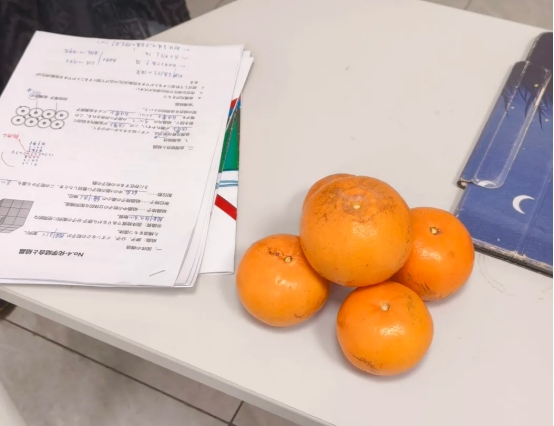
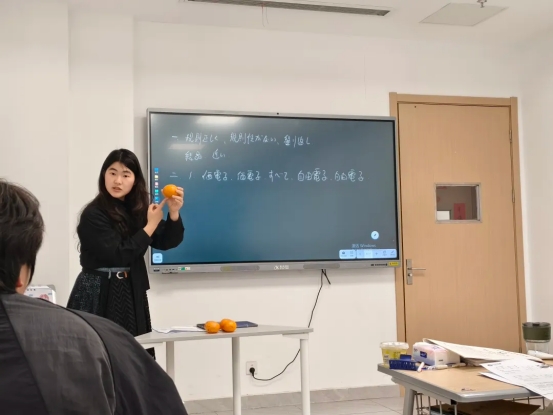
In an seemingly ordinary chemistry class, the protagonists on the podium were not complex instruments, but nine ordinary oranges. Mr. Guo, from the EJU Science of the International Academy, vividly demonstrated the mysteries of metal crystal structures using the simplest teaching aids, providing a model of "seeing the big in the small" for classroom teaching.
Boundless Aids:
From Everyday Objects to Scientific Models
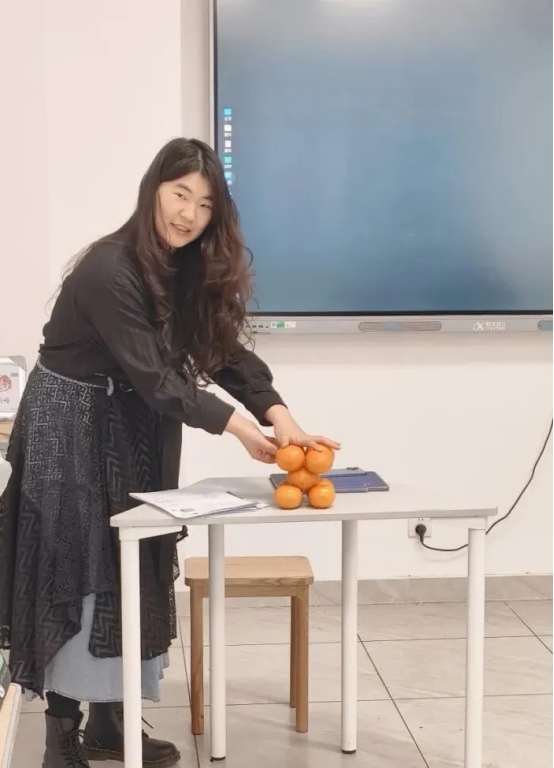
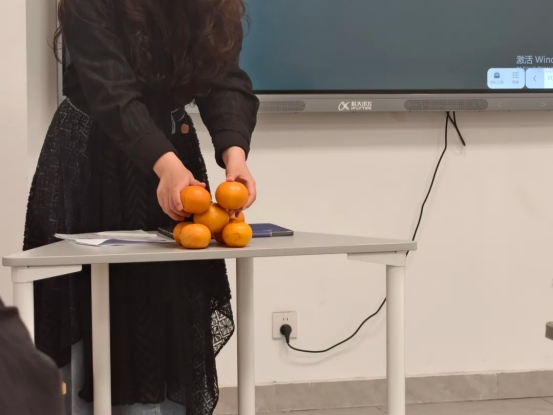
Against the backdrop of pursuing digitalization and intelligence, this class chose to return to basics, using oranges as atomic models. The teacher guided students intuitively feel the core difference in spatial arrangement between "body-centered cubic" and "face-centered cubic" structures through observation and stacking—one relatively loose, the other more dense
This concrete experience derived from daily life made the originally abstract knowledge visible, tangible, and understandable.
Making Thinking Tangible:
Constructing Scientific Logic through Derivation
Demonstration is merely the starting point; thinking and derivation are the true core of the.
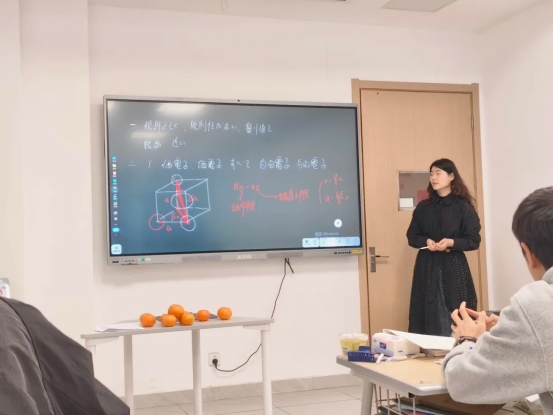
Starting from a simple spherical model, Mr. Guo leads his students through step-by-step calculations and progressive reasoning: first, by using geometric relationships, they establish a quantitative between the unit cell (cubic lattice) edge length and the atomic radius—such as √3a=4r in body-centered cubic and √2a=4r in-centered cubic; then, based on this, they calculate the total volume of atoms within a single unit cell; finally, by comparing it with the total volume of the unit cell they derive the two key conclusions that "the packing efficiency of body-centered cubic is about 68%" and "the packing efficiency of face-centered cubic is about 74".
Vision Fusion:
Connecting Disciplinary Terminology with Diverse Contexts
This accessible and profound course stems from the instructor's extensive teaching experience. Ms. Guo from Central China Normal University and began her teaching career in 2017, working in science education in both China and Japan. After solidifying her foundation with two years of in China, she taught in Japan for seven years, accumulating rich experience in integrated science education.
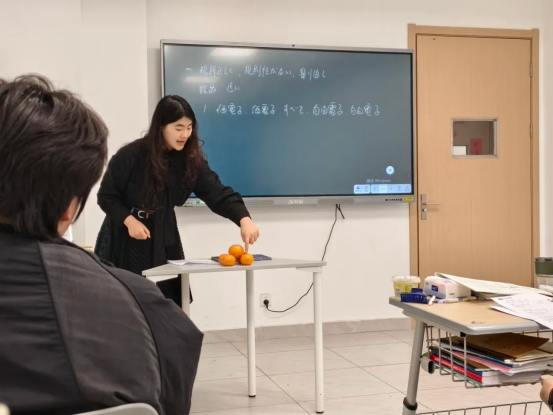
This teaching experience of integrating cross-cultural studies with science is also fully reflected in Ms. Guo's classes. She naturally places key concepts within diverse academic for explanation.
For example, when analyzing the properties of crystals, in addition to explaining that "metallic crystals are malleable," she also introduces a fine distinction from the Japanese language"ductility" (延びる性質, stretchability) and "malleability" (広がる性質, spreadability).
When deriving the packing fraction formula, she also explains the physical significance of each step simultaneously: from the geometric relationship of the "body-centered cubic lattice diagonal (body-centered cubic unit cell diagonal) to the step-by-step calculation of the "total atomic volume per unit cell" (total atomic volume within a single unit cell
In such a teaching process, students not only master the universal language of science but also gradually come to understand professional expressions in different contexts.
Reflections on Education:
When nine oranges meet the craftsmanship of education
The oranges will be eaten, and the experiment will end, but what such a classroom with students is far more than just the numbers 68% and 74%; it lies in how to reach the deepest understanding through the simplest means.
Perhaps the answer is within each heartfelt "presentation" and solid "derivation".
As the fresh fragrance of oranges still gently lingers in the classroom, the seeds of science have already quietly taken root in hearts of the youth.