Isn't learning Japanese enough for studying abroad in Japan? Why do we still need to take TOEFL? "Many parents have this question when they first learn about the English requirements for studying abroad in Japan.
In fact, with the increasing internationalization of Asian universities, English proficiency has gradually become an important reference for many applications to prestigious schools.
University of Tokyo, Waseda University, Keio University, whether it is the SGU English taught program or the EJU application, an excellent TOEFL score can not only prove a student's academic English ability, but also further enhance their competitiveness in the application process. A TOEFL score of 4 or above (old TOEFL score of 80) is also an important bargaining chip to prove English proficiency and widen the competitive gap.
TOEFL is not a "bonus point",
But it's a must-have for many prestigious schools
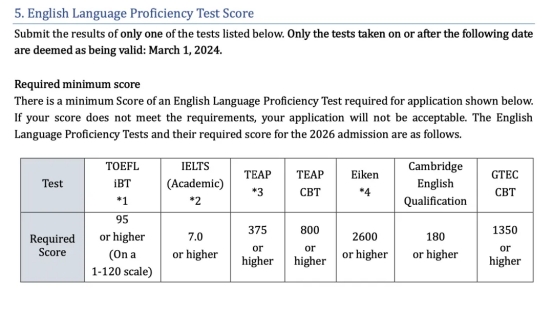 (Taking the 2026 Waseda University SGU application as an example, the minimum TOEFL requirement is an old TOEFL score of 95, which means a new TOEFL score of 4+)
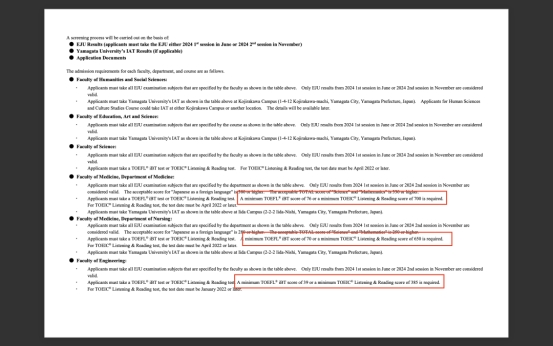
(Taking the EJU application at Yamagata University in 2025 as an example, multiple departments and colleges have minimum TOEFL requirements)

In this year's senior year of high school, the International Academy's Chinese and Japanese classes submitted an impressive report card: 2 students scored 5 or above (old TOEFL score of 100); 6 people with a score of 4.5 or above (old TOEFL score of 90); A score of 4 or above accounts for over 50%.
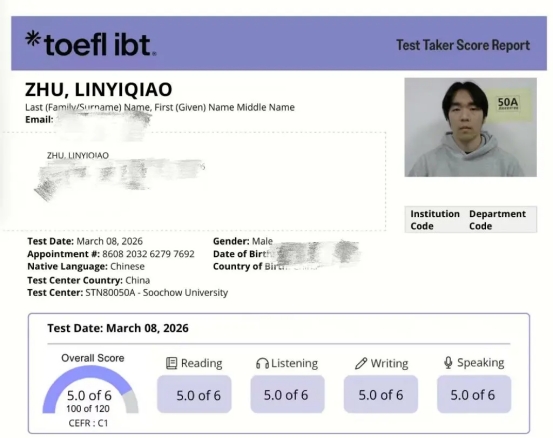
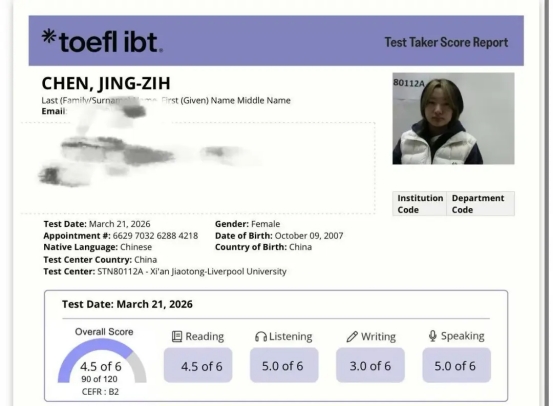
This time, we invited two high school seniors who performed outstandingly in the 2026 TOEFL exam - Zhu Linyiqiao (total score of 5) and Chen Jingzi (speaking score of 5) - to share their practical experience.
Whether you are preparing for TOEFL or just starting out, I hope their experience can help you avoid some detours.
Infuse English into daily life
Hello everyone, I am Zhu Lin Yiqiao, a senior student majoring in Chinese and Japanese studies at the International Academy. In this year's new TOEFL exam, I achieved a total score of 5 points. Looking back at the preparation process, I think the most important thing is to integrate English into daily life.

01
Understand the reform direction of the new TOEFL
The new TOEFL focuses more on "practical English" - there will be text messages and advertisements in reading, and letter tasks in writing. These question types not only test academic skills, but also emphasize practical application abilities in real life.
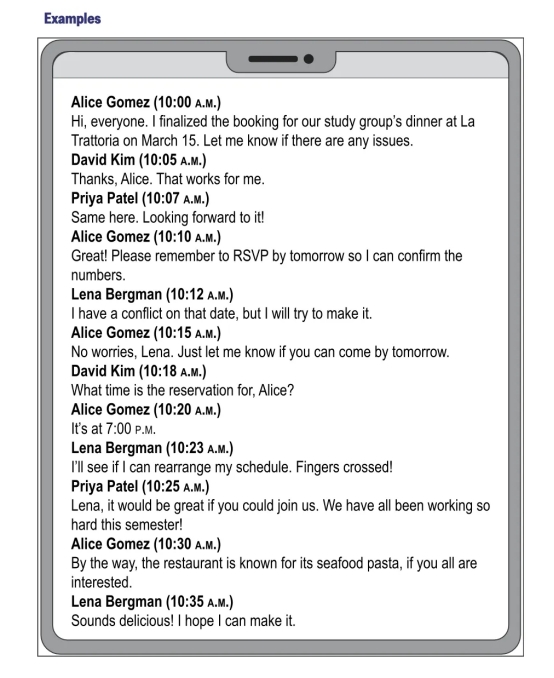
(The new TOEFL reading test adds life related texts such as text messages, letters, advertisements, and notifications. It places more emphasis on testing students' reading abilities for different materials.)
02
Don't just brush up on questions, immerse yourself in English culture
This ability is difficult to obtain solely through practicing questions. I am usually interested in English and English culture, and often watch American TV shows and comics. Long term input makes understanding of daily expressions natural and greatly helps in dealing with new types of questions. Learning a language and watching original film and television works is a very effective way.
03
Persist in clocking in and accumulating small details
During my three years of study in the academy, I participated in business competitions, theatrical performances, voice acting, and other activities. In the sprint stage, I also persist in practicing real exam questions and oral retelling exercises, maintaining my touch every day.
Learning English is a long-term process, and teachers are always our most important support. Seeking advice promptly when encountering problems can save a lot of detours.


During his three years at the International Academy, Zhu Lin Yiqiao participated in a variety of language activities, such as theatrical performances, voice acting, etc
Speak up, not afraid of mistakes, practice fluency
Hello everyone, I am Chen Jingzi, a senior high school student from the International Academy. In the new TOEFL exam, I achieved a total score of 4.5 and a score of 5 in the speaking section. I would like to share some personal tips for improving TOEFL speaking skills with my younger students in the short term.

01
Read more and accumulate more, integrate into life
I usually open the app to look up and listen to the pronunciation of unfamiliar English words on packaging or billboards. Over time, vocabulary will accumulate unconsciously, and pronunciation can also improve together.
When watching movies and American TV shows, I also try to choose the original English version as much as possible, cover the subtitles first to listen attentively, and then check the content against the subtitles. This method is very helpful for paraphrasing questions in TOEFL.
In addition, I often do sentence expansion exercises to train my ability to understand and remember long and difficult sentences by continuously extending the sentence structure. By utilizing fragmented time to accumulate language materials and combining it with extensive practice in a short period of time, the effect will be more significant.
(Utilize fragmented time to practice sentence expansion and expand one's own corpus)
02
Create a language environment for oneself
Choose English content that truly interests you to watch, listen to, and practice. Once it is a field that one loves, there will naturally be a desire to understand and comprehend, and learning will be easier to persist in.
When practicing English expression, don't always worry about whether your vocabulary is advanced enough. Rather than complex expressions, it is more important to have the courage to speak up. Even talking to oneself is training one's language output ability.
At the same time, it is necessary to persist in "ear grinding" for a long time and not overly rely on translation. It's better to listen and read English a few times rather than just skim through the meaning, so that it can truly become a language that can be naturally understood and used by oneself.


03
Persist in checking in for oral communication and practice every week
During the preparation period, I persisted in weekly oral check ins with my English teacher, focusing on practicing paraphrasing questions, personal experience questions, and multiple-choice question types.
During the practice process, I will pay special attention to controlling my speaking speed, not deliberately pursuing "speaking fast", but trying to pronounce each word clearly and express it completely. Compared to speaking too fast but frequently stuttering, stable and natural expression is often easier to achieve high scores.
For spoken language, the most important thing is actually fluency.

(Persist in checking in for oral communication and practice every week)
It is not difficult to find several commonalities from the sharing of the two classmates.
Firstly, it is' immersive learning '. Whether it's watching original English movies and TV shows, casually searching for English expressions in daily life, or accumulating language sense through sentence expansion exercises, they are gradually transforming English from an "exam subject" into a language used in daily life.
Next is' long-term persistence '. Weekly oral check ins, repeated ear grinding, and utilizing fragmented time to accumulate language materials... seemingly ordinary daily exercises gradually accumulate into breakthroughs on the transcript.
For many students pursuing international education, TOEFL is no longer just an "add-on", but an increasingly important language proficiency test.
But on this road, you are not alone - teachers, classmates, and the experiences of these seniors can all be your stepping stones.
I hope your name will also be on the next impressive transcript.